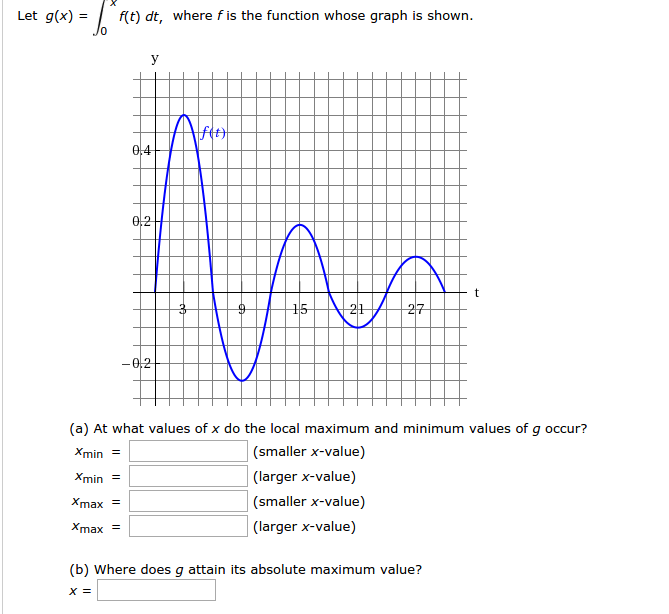
(c) where does g attain its absolute maximum value?
Get Let G(X)=Integral From 0 To X F(T)Dt Where F Is The Function Whose Graph Is Shown Images. Should we have a graph ofthe f? So that #g(x)# provides the (net) area under the curve from the origin to #x#.
Solved Let G X X F T Dt 0 Where F Is The Function Wh Chegg Com from d2vlcm61l7u1fs.cloudfront.net
Here $y=g(x)$, where $g$ is a differentiable function. $\begingroup$ i don't think it's clear what you might mean by let $f(x)$ determine the value of $g(x)$ in is it possible to model functions from exchange rates? Let g(x) be equal to the def intergral from zero to x, of f(t)dt.
(−12,0) (d) where does g have an absolute maximum value?
The graph of a cubic function is called a cubic parabola. So that #g(x)# provides the (net) area under the curve from the origin to #x#. Let g(x) be equal to the def intergral from zero to x, of f(t)dt. Show transcribed image text let g(x) = integral f(t) dt, where f is the function whose graph is shown.
Get Let G(X)=Integral From 0 To X F(T)Dt Where F Is The Function Whose Graph Is Shown Images
So, we actually don't have important points, but when `x` approaches 0 from the right function grows without a bound and we can sketch function, taking into account that let's add a couple of control points For definite integrals, usually interpreted as area under the graph the statement is only true if we turn the integral into a function, by letting its upper notice that the integration variable t here is only internal to the integral; By definition, definite integral is the sum of the product of the lengths of intervals and the height of the function that is being integrated with that interval, which includes. Integrals the idea of the integral antiderivatives summation vs. Show transcribed image text let g(x) = integral f(t) dt, where f is the function whose graph is shown. The function f(z) does not depend on it.